On the Subject of Leadership cover art

On the Subject of Leadership

On the Subject of Leadership

By: Dr Robert N. Winter
Listen for free

On the Subject of Leadership is a long-form conversation about what makes organisations work—and why much of what passes for leadership advice does not. Each episode features an executive or practitioner whose conclusions have been tested in consequential settings. The work is analytical, not anecdotal: incentives, power, trust, culture, and the limits of authority. Ideas are challenged, not affirmed. This is not motivational theatre. It is a search for what holds up under pressure. If you take leadership seriously and are sceptical of easy answers, this is for you.Copyright 2026 Dr Robert N. Winter Economics Management Management & Leadership Philosophy Social Sciences
Episodes
  • Ken Sandy: Influence Was Always the Point
    Jun 9 2026

    Most conversations about artificial intelligence and the product manager begin by asking whether the role survives. This one begins somewhere more useful: by asking what the role was ever actually for. In this episode of On the Subject of Leadership, I speak with Ken Sandy—author of The Influential Product Manager, the lecturer who built the first product management course in the engineering school at UC Berkeley, a longtime executive coach to founders and executives, and an adviser to boards—about what is left of product leadership once the artifacts that used to define it can be produced in seconds.

    Ken's argument is not the reassuring one. The documents, specifications, and roadmaps product managers are most often judged by, he contends, were never the work; they were the residue of the work. The work was always the influence—the grounding in evidence, the advocacy for the customer, the patient assembly of agreement among people who do not report to you. If that is right, the commoditisation of the artifacts is not a threat to the discipline but a solvent applied to it: it dissolves what was never essential and leaves the essential in plain view.


    This is a conversation about leadership at least as much as product. It moves from the counter-intuitive proposition that having no authority is an advantage, through the documents organisations cling to long after anyone reads them, to the questions boards are asking about AI—and the rather better questions Ken believes they should be asking instead.


    Takeaways

    1. Why the absence of formal authority is not a constraint to work around, but the very thing that forces sound product judgement.
    2. Renewal as subtraction: why growth is often a matter of forgetting the right things, not learning new ones.
    3. The artifacts organisations sustain as ceremony, long after the people demanding them have stopped reading them.
    4. The two anti-behaviours of AI-era product work: skipping the thinking, and feeding the beast.
    5. Why boards ask risk-aversion questions when they should be asking opportunity questions—and why a director who has never used the tools can do neither well.
    6. Deterministic versus probabilistic products, and what the distinction demands of governance.
    7. Intent over permission: the leadership move that keeps momentum without burning trust.


    Chapters

    [00:00] Introduction
    [04:41] What influence actually means
    [10:00] Why having no authority is an advantage
    [17:29] One skill in, one skill out: the forced choice
    [24:42] The artifacts we cling to
    [33:07] Two anti-behaviours: skipping the thinking, feeding the beast
    [40:58] Curiosity over age, and the fear of the tools
    [45:33] The board's wrong questions: risk versus opportunity
    [54:19] Deterministic versus probabilistic, and what directors must understand
    [01:02:51] The chapter to read first, and the one to revise
    [01:09:27] Lightning round and close


    Guest Links & References

    • Ken Sandy
    • Influential Product Manager
    • Referenced in this episode: L. David Marquet, Turn the Ship Around! (2013)


    About the Show

    On the Subject of Leadership is a long-form interview series on governance, organisational culture, and the realities of decision-making — without slogans or motivational gloss.


    Hosted by Dr Robert N. Winter.


    Subscribe / Follow

    Newsletter / Website: robert.winter.ink

    LinkedIn: dr-robert-winter

    X: @DrRobertWinter

    Instagram: DrRobertWinter

    Mastodon: social.winter.ink/@robert

    YouTube: @OnTheSubjectOfLeadership


    Credits

    Recorded remotely via Riverside

    Music: The Hidden Thread by Roberto Prado / Artlist

    Show More Show Less
    1 hr and 20 mins
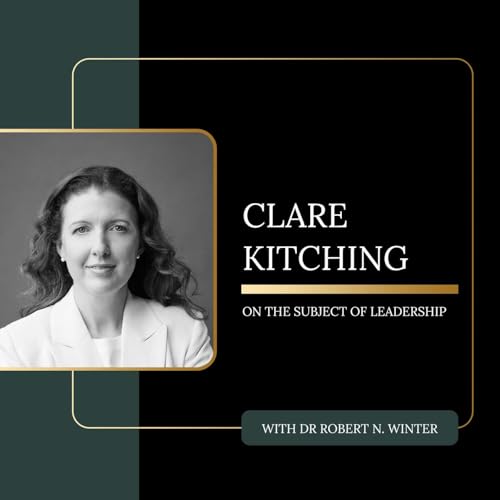
  • Clare Kitching: Make My Business Grow, How Can I Do This?
    May 26 2026

    Most organisations now claim to be adopting artificial intelligence. Far fewer can describe what they are actually adopting it into. In this episode of On the Subject of Leadership, I speak with Clare Kitching, founder of Cambiq Consulting—formerly of McKinsey, QuantumBlack, and Treasury Wine Estates—about what responsible AI leadership actually requires in this country, at this moment.

    Clare's argument is organisational rather than technological: governance cannot exist as a paper exercise; shadow AI persists because employees do not know whether policies exist; and the genuinely strategic question—how do I grow my business—is precisely the question the technology cannot answer for you.


    Takeaways

    1. The institutional credibility leaders quietly outsource, and what is left when they leave.
    2. Why executives who have never logged in cannot lead AI adoption credibly.
    3. The difference between what clients say they want to know and what they are actually asking.
    4. The portfolio of productivity, growth, and reimagination—and why most organisations confuse the three.
    5. Curiosity as the distinguishing trait, regardless of age or education.
    6. The maintenance problem for which nobody planned.
    7. The team-level conversation that has yet to happen in most organisations.


    Chapters

    [00:00] Introduction
    [03:44] Welcome & opening question
    [04:37] Outsourcing your identity to the institution
    [07:36] Buzzwords versus business problems
    [10:24] What to unlearn from McKinsey
    [13:09] The executive who has never used AI
    [17:03] Just get started: the case for low-stakes entry
    [19:41] The best AI tool is the one you use
    [22:01] Chasing the bleeding edge: a waste of attention
    [24:25] Shopping for permission, or open to challenge?
    [26:54] No excuses: curiosity as the differentiating trait
    [29:27] It's not age, it's not education: the mindset argument
    [31:45] Curiosity, cognitive load, and burnout risk
    [33:11] AI as a brainstorming partner: the filtering problem
    [34:07] Productivity, growth, or reimagination: the portfolio question
    [36:42] You can't cut your way to success, even with AI
    [37:33] When to go for efficiency gains first
    [39:41] The question AI cannot answer: how to grow your business
    [41:03] Risk appetite, psychological safety, and where to start
    [42:07] Freeing up time: staff development as the upside
    [42:58] The three-month journey to meaningful adoption
    [45:51] AI is not set-and-forget: the maintenance problem
    [47:11] The bottom-up conversation: rank and file as drivers
    [49:17] Three bullet points versus three pages: the volume problem
    [50:53] Synthesis as a leadership discipline
    [52:38] Lightning round
    [54:03] Close


    Guest Links & References

    • Clare Kitching
    • Cambiq Consulting


    About the Show

    On the Subject of Leadership is a long-form interview series on governance, organisational culture, and the realities of decision-making — without slogans or motivational gloss.


    Hosted by Dr Robert N. Winter.


    Subscribe / Follow

    Newsletter / Website: robert.winter.ink

    LinkedIn: dr-robert-winter

    X: @DrRobertWinter

    Instagram: DrRobertWinter

    Mastodon: social.winter.ink/@robert

    YouTube: @OnTheSubjectOfLeadership


    Credits

    Recorded remotely via Riverside

    Music: The Hidden Thread by Roberto Prado / Artlist

    Show More Show Less
    54 mins
  • Nine Years, One Number
    May 19 2026

    A bonus release from the Inner Circle feed, made available to all listeners. Weekly article readings are normally reserved for Inner Circle members; this is the opening piece of a four-part series, opened more widely as a way in. The remaining three articles are available to read at robert.winter.ink or to hear on the Inner Circle's private podcast feed. Join the Inner Circle at robert.winter.ink


    For nine consecutive years, three of the world's most influential research operations have surveyed thousands of executives on artificial intelligence. The technology has matured through three or four generational shifts. The proportion of organisations capturing real financial value from any of it has remained, with a stubbornness that is almost dignified, somewhere between five and twenty per cent. This article sets out the longitudinal evidence, names the half-lie that allows the contemporary conversation to ignore it, and previews the three pieces to follow.


    In This Article

    • The technology has changed enormously. The numbers have not. MIT and BCG in 2017 found that five per cent of companies had extensively incorporated AI; McKinsey in 2025 finds six per cent capturing meaningful EBIT impact. The proportion has moved within a narrow band for nearly a decade.
    • "AI is moving too fast for the surveys to be reliable" is the half-lie at the centre of the executive conversation. The technology is moving fast at the level of model capability. It is not moving fast at the level of enterprise value capture, which is the level a board needs to care about. The conflation provides cover for the executive who cannot deliver.
    • Research for Governing Digital with Courage and Clarity surfaced an unusual pattern of anonymity. Contributors who saw the landscape clearly were happy to be named. Those insisting on the convenient lie — that the inconvenient findings were stale — would only speak unattributed.
    • Trollope worked out the social mechanics 150 years ago. In The Way We Live Now (1875), Augustus Melmotte raises capital across London society for a railway that will never be built. The fraud is not in the prospectus. The fraud is in the dinner.
    • These numbers are the empirical case for the saviour industrial complex thesis: the substitution of expensive acquisition and confident signalling for the patient development of organisational capacity.
    • Three pieces follow this one. The Permanent Pilot examines why only a quarter of organisations have moved AI to production after nine years of trying. The Theatre of Transformation examines the gap between deep-transformation claims and the absence of job redesign. The Books That Don't Balance, reserved for Inner Circle members, ties the threads together with a six-question diagnostic for boards.

    A Thought With Which To Sit

    Those who tell whole lies are merely concealing the truth. Those who tell half-lies have forgotten where they put it.


    Coming Up

    The remaining three articles in the series are available to read on the site and to hear on the Inner Circle's private podcast feed. Subscribe via the Commons at robert.winter.ink for site access, or join the Inner Circle for the audio.


    Further Reading

    • Trollope, A. — The Way We Live Now (1875).
    • Ransbotham, S., Kiron, D., Gerbert, P., & Reeves, M. — Reshaping Business with Artificial Intelligence (2017).
    • McKinsey & Company — The State of AI in 2025: Agents, Innovation, and Transformation (2025).
    • Khurana, R. — Searching for a Corporate Savior: The Irrational Quest for Charismatic CEOs (2002).
    Show More Show Less
    11 mins
adbl_web_anon_alc_button_suppression_t1
No reviews yet