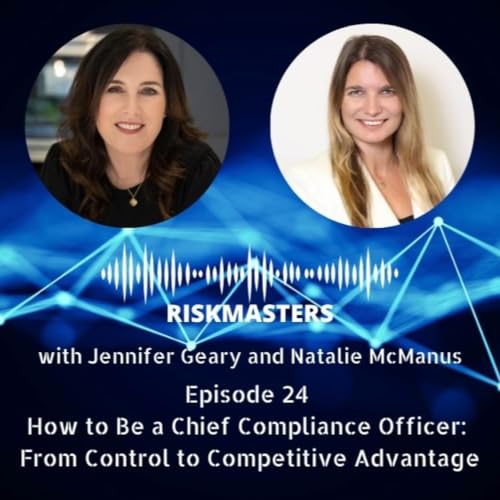
• Chief Compliance Officer role explained. Jennifer Geary and Natalie McManus explore compliance leadership, strategy, and decision-making.
    Jun 16 2026

    In this RiskMasters episode, Julien Haye speaks with Jennifer Geary and Natalie McManus, co-authors of How to Be a ChiefCompliance Officer.

    The conversation explains the Chief Compliance Officerrole as a leadership discipline rather than a control function.

    It explores how compliance leadership shapesdecision-making, supports strategy, and embeds culture across the organisation.

    Drawing on practical experience, the discussion reframescompliance as a capability that enables sustainable performance, trust, and long-term value.


    🧠 What Does a Chief Compliance Officer Do?

    A Chief Compliance Officer ensures that an organisationoperates within regulatory expectations while enabling effective decision-making.

    The role combines governance, culture, and advisoryinfluence to shape how organisations manage risk, interpret rules, and minimise harm.

    In practice, this means embedding compliance into strategy,operations, and everyday decisions rather than applying it after the fact.


    🎯 What You’ll Learn

    • Why every senior leader operates as a compliance leader inpractice
    • How compliance mindset improves escalation and decisionquality
    • What defines the Chief Compliance Officer role today
    • How compliance leadership creates competitive advantage
    • Why most compliance programmes fail to influence decisions
    • How the IMPACT Wheel connects compliance into a system


    ⏱️ Episode Highlights

    00:02 – Introduction and framing of the CCO role
    00:54 – Compliance as leadership and social purpose
    05:34 – Misconceptions about the Chief Compliance Officer
    11:55 – Compliance as competitive advantage in practice
    26:49 – The IMPACT Wheel explained
    41:25 – First 90 days as a Chief Compliance Officer46:23 – Future capabilities: data, AI, and human judgement

    📚 Related Resources

    From Approval to Impact: Repositioning Risk Appetite as a Board ToolUnderstand how governance frameworks influence real business outcomes

    What Would Change if Risk Identification Was Treated as a Strategic Advantage?Reframe how organisations surface and act on emerging risks

    Psychological Safety in Risk Management
    Why escalation, culture, and speaking up define effective governance


    🎓 Download your CPD certificate:

    The CPD Group – Accreditation #

      Show More Show Less
      57 mins
    • Risk Culture, Governance and Operational Resilience in Crisis Management
      Jun 8 2026

      Risk culture plays a central role in operational resilience, particularly in environments shaped by uncertainty and rapid change.


      In this segment, Bruce McIndoe explains why governance structures in risk management and crisis management often appear robust but struggle under real conditions.


      He highlights how organisations rely on defined roles, escalation paths, and reporting structures, yet face challenges in speed, integration, and decision-making when ambiguity increases.


      The discussion explores how culture influences whether early warning signals are surfaced, how oversight shapes behaviour, and how operational resilience depends on the ability to act before information is fully validated.


      Listeners will gain insight into:

      • How risk culture influences operational resilience and crisis response
      • Why governance structures provide confidence but not always effectiveness
      • How speed and integration become critical under pressure
      • Why oversight can delay escalation when certainty is prioritised
      • What this means for enterprise risk management and decision-making


      Enterprise risk management, crisis management, and governance frameworks often emphasise structure, reporting, and control.


      Operational resilience depends on how organisations behave when conditions are uncertain.


      This includes:

      • how early signals are surfaced
      • how ambiguity is treated in decision-making
      • how quickly teams can act across functions


      Strengthening these capabilities improves business resilience and response effectiveness.


      This extract is taken from the full RiskMasters interview with Bruce McIndoe on operational resilience, risk management, and crisis decision-making.

      Show More Show Less
      7 mins
    • Operational Resilience, Enterprise Risk Management & Crisis Management: Why Early Signals Fail
      May 30 2026

      Early warning signals in operational risk, enterprise risk management (ERM), and crisis management environments are often present before disruption becomes visible.

      In this segment, Bruce McIndoe explains why these signals frequently fail to trigger action. He highlights how ambiguity, fragmentation, and competing interpretations prevent organisations from recognising signals as decision-relevant.

      The discussion provides a practical lens on how risk monitoring and business continuity planning (BCP) can be strengthened by improving signal interpretation and escalation.


      What You Will Learn

      Listeners will gain insight into:

      • Why early warning signals are often identified but not acted upon
      • How enterprise risk management and crisis management processes interpret signals differently
      • Why ambiguity prevents signals from becoming decision-relevant
      • How fragmentation across functions delays escalation
      • What this means for chief risk officers and business resilience leaders


      Why This Matters

      Many organisations invest in risk monitoring, enterprise risk management, and business continuity planning to strengthen resilience.

      These capabilities depend on more than detection.

      Operational resilience requires organisations to interpret signals under uncertainty, prioritise action, and respond before disruption escalates.

      This is a critical capability for leaders responsible for risk management, crisis management, and business resilience.


      Full Episode

      This extract is taken from the full RiskMasters interview with Bruce McIndoe on operational resilience, enterprise risk management, and crisis decision-making.


      Show More Show Less
      7 mins
    • Operational Resilience vs Risk Reporting: What Leaders Get Wrong
      May 23 2026

      Most organisations believe strong risk reporting indicates strong operational resilience.


      In this segment, Bruce McIndoe challenges that assumption. Drawing on his experience in enterprise risk management (ERM), crisis management, and business continuity planning (BCP), he explains why reporting and monitoring provide visibility but do not determine whether an organisation can continue to operate under disruption.


      The discussion explores how operational resilience depends on the ability to interpret emerging signals, connect information across functions, and act before conditions escalate.


      What You Will Learn

      Listeners will gain insight into:

      • Why risk reporting and risk monitoring do not reflect operational resilience
      • How enterprise risk management frameworks can create visibility without readiness
      • Why early signals in crisis management and BCP environments are often not acted upon
      • How fragmentation across functions limits business resilience
      • What this means for chief risk officers and senior leaders


      Why This Matters

      Many organisations continue to strengthen risk management frameworks, monitoring processes, and reporting structures.

      These improve oversight and support governance.

      Operational resilience depends on a different capability: the ability to recognise emerging disruption, make decisions under uncertainty, and maintain continuity when conditions change.

      This distinction is critical for leaders responsible for enterprise risk management, crisis management, and business continuity.


      Full Episode

      This extract is taken from the full RiskMasters interview with Bruce McIndoe on operational resilience, enterprise risk management, and crisis decision-making.


      Show More Show Less
      7 mins
    • Operational Resilience, Risk Management and Crisis Decision-Making with Bruce McIndoe
      May 16 2026
      In this episode of RiskMasters, I speak with Bruce McIndoe, founder of iJET and WorldAware, and a global expert in operational resilience, crisis management, and risk management in complex environments.With decades of experience across intelligence systems, NASA programmes, and Global 2000 advisory, Bruce brings a practical perspective on how operational risk, organisational fragmentation, and leadership decision-making interact under pressure.This conversation focuses on a critical but often misunderstood reality: operational resilience is not a reporting outcome. It is a capability that determines whether organisations can detect early signals, coordinate effectively, and act before disruption escalates into crisis.🎯 What You Will LearnHow operational resilience differs from traditional risk management frameworksWhy operational risk builds through fragmentation, not isolated failures How crisis management fails when coordination breaks down under pressure Why early warning signals are often visible but not acted upon How human judgement remains critical in interpreting ambiguous risk signals Practical ways to strengthen coordination across functions and improve resilience 🕒 Episode Highlights02:30 — Risk reporting vs operational resilienceWhy risk registers and heat maps create governance clarity but fail to indicate whether the organisation can continue to operate under disruption.07:15 — How disruption actually emerges in operational risk environmentsWhy crises do not appear as clear, linear events, but develop through fragmented and ambiguous signals across functions.10:55 — Intelligence fusion and missed early warning signalsHow operational risk signals exist across silos, but are rarely connected early enough to inform decision-making.14:40 — Crisis management and behavioural breakdownsWhy organisations do not follow plans under pressure and instead fall back on coordination, relationships, and decision habits.25:15 — Governance structures and operational resilience limitsHow governance frameworks provide oversight but struggle to operate effectively in fast-moving, uncertain conditions.47:20 — The hardest truth about resilience and risk managementWhy resilience cannot be delegated and depends on real organisational capability, not documentation.💡 Key Insight“Resilience cannot be delegated, and it cannot be faked. It shows up in how organisations coordinate and make decisions when conditions change.”👤 About Bruce McIndoeBruce McIndoe is the founder of iJET, later WorldAware, and a recognised expert in operational resilience, crisis management, and global risk intelligence.He has spent decades helping organisations strengthen their approach to operational risk and crisis management by improving early warning capabilities, cross-functional coordination, and decision-making under pressure.Find Bruce on Linkedin: https://www.linkedin.com/in/mcindoe/📚 Related ResourcesPsychological Safety in Risk Leadership From Approval to Impact: Repositioning Risk Appetite Strategic Risk Identification as a Capability Strategic Uncertainty Governance Risk Capacity and Operational Decision-Making 🎓 Download your CPD certificate:The CPD Group – Accreditation #501195
      Show More Show Less
      53 mins
    • Risk Culture, Risk Ownership and Decision-Making Under Pressure
      May 9 2026

      Risk culture, risk ownership, leadership, and risk management become visible through how organisations make decisions under pressure.


      In this RiskMasters — The Download segment, Leroy Roberts explores how unclear ownership, weak support structures, and slowing decisions create decision drag and increase organisational risk exposure. The discussion focuses on how chief risk officers, boards, and leadership teams can strengthen risk management by improving risk ownership, operational clarity, and leadership support.


      The conversation also explores why organisations often believe existing governance and escalation processes are sufficient, while underlying control gaps continue to create operational and strategic risk.


      Listeners will gain insight into:

      • How risk ownership influences decision-making and control effectiveness
      • Why decision drag signals weakening risk culture
      • How leadership support strengthens risk management outcomes
      • Why delegation without support increases operational and strategic risk
      • How organisations can strengthen control through clearer accountability and decision cadence


      This extract is taken from the full RiskMasters interview with Leroy Roberts on risk culture, leadership, risk management, operational risk, and governance, available on Apple Podcasts, Spotify, and at aevitium.com.

      Show More Show Less
      8 mins
    • Decision Drag: Risk Culture, Risk Ownership and Decision-Making Signals
      May 2 2026

      Risk culture, risk management, and risk ownership become visible through how decisions are taken in practice.


      In this RiskMasters — The Download segment, Leroy Roberts explores decision drag as an early signal of weakening control, showing how slowing decisions and unclear risk ownership affect risk management outcomes and leadership effectiveness. For chief risk officers, board directors, and risk leaders, this provides a practical way to observe risk culture and control in real time.


      The discussion focuses on how decision-making behaviour reflects the strength of governance and highlights why delays, escalation patterns, and ownership clarity are critical indicators of operational risk.


      Listeners will gain insight into:

      • How risk culture shapes risk decision-making and control
      • Why decision drag signals changes in risk ownership and accountability
      • How leadership behaviour influences escalation and decision clarity
      • How chief risk officers and boards can observe risk management effectiveness through decision patterns


      This segment is extracted from the full RiskMasters interview with Leroy Roberts on risk culture, leadership, risk management, and operational risk, available on Apple Podcasts, Spotify, and at aevitium.com.

      Show More Show Less
      5 mins
    • What Boards and Chief Risk Officers Often Miss About Risk Culture
      Apr 25 2026

      Risk culture, risk decision-making, and operational risk are deeply connected, yet often managed separately.


      In this RiskMasters — The Download segment, Leroy Roberts explores how risk culture operates as a control mechanism shaping risk management, leadership decisions, and governance outcomes. For chief risk officers, board directors, and operational risk leaders, the discussion offers a practical lens on how culture influences control effectiveness long before formal incidents emerge.


      Listeners will gain insight into:

      • How risk culture strengthens risk management and decision-making
      • Why behavioural signals can act as early indicators in operational risk
      • How chief risk officers and board directors can view culture through a control lens
      • Why governance effectiveness depends on how decisions and escalation work in practice


      This extract is taken from the full RiskMasters interview with Leroy Roberts on risk culture, leadership, operational risk, and risk decision-making, available on Apple Podcasts, Spotify, and at aevitium.com.

      Show More Show Less
      5 mins