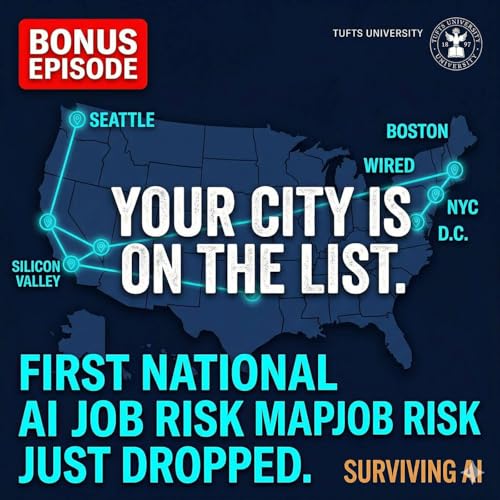
• Silicon Valley Has the Highest AI Job Risk in America | Tuft's New Data Is Wild
    Apr 1 2026

    Send us Fan Mail

    Tufts University just released the first-ever American AI Jobs Risk Index (March 24, 2026) — and the results are not what most people expected. Silicon Valley has the highest AI job risk of any U.S. city at 9.9%. Boston, D.C., Seattle, New York — the Wired Belts — are the most exposed. Writers face 57% displacement risk. Computer programmers 55%. And the day after this report dropped, ADP published a survey of 39,000 workers: only 22% feel their job is safe. On this week's bonus episode, Carlo Thompson breaks down every number, explains what the geographic story means for your career, and gives you four specific actions to take this week.

    📊 Sources: Tufts Digital Planet (March 2026), ADP Research Today at Work 2026, Fortune/Duke CFO Survey

    👂 Listen on Apple Podcasts: https://podcasts.apple.com/us/podcast/surviving-ai-job-automation-workforce-future-insights/id1864360631
    ▶️ Subscribe on YouTube: https://www.youtube.com/@SurvivingAIRisk/video

    Episode resources

    https://docs.google.com/document/d/12w6mzGndqtqx4tlHFxaQ2lu80bHIcnxMgIIWo5ltZXs/edit?usp=sharing

    American AI jobs risk index 2026, Tufts Digital Planet AI jobs, Wired Belts Rust Belts AI, AI job displacement by city, Silicon Valley AI risk, ADP job security survey 2026, CFO AI layoffs confession, writer programmer AI risk, AI automation geography, 9.3 million jobs AI risk

    Show More Show Less
    22 mins
  • One Job, One Failure Point. Here's The Backup Plan | How to start an AI consulting side business
    Mar 30 2026

    Send us Fan Mail

    Your job is your single point of failure. Build an insurable side business earning $2K/month in 6 months. Here's exactly how.

    A restructuring. A merger. One decision from leadership you can't control. Your main job disappears. You've got savings, unemployment, maybe severance. But that covers you for how long? Two months? Three?


    Here's what most people don't realize: a side business earning just $2,000 per month doesn't make you rich. But it covers 57% of your basic living expenses. It buys you six months of runway. It turns panic into strategy. It moves you from dependent to strategic.


    In this episode, Carlo breaks down the complete framework: the three business models that actually work in 2026 (AI implementation services, protected service businesses, AI-enhanced traditional models), the five non-negotiable launch criteria that separate real opportunities from time-wasting distractions, the realistic 6-month launch plan (validation, refinement, systems, growth, scale, decision point), and the honest pricing and time management strategy that keeps this as insurance, not a second job. You'll learn how to validate ideas in month one, land your first three customers by month three, hit $2,000/month by month five, and decide what's next. Includes the exercise: identify your side business, validate it, and commit to your first three customers this week. Direct, evidence-based, actionable. For professionals aged 25-55 who understand that career resilience starts with building income you control.

    Show More Show Less
    49 mins
  • 59% of Companies Are Faking AI Layoffs — Here's How to Tell
    Mar 25 2026

    Send us Fan Mail

    Block just fired 4,000 people — a 40% workforce reduction. CEO Jack Dorsey called it AI-driven automation. The company reported $2.87 billion in profit, up 24% year-over-year. Their stock soared 24% after the announcement.

    This isn't an isolated case. New research reveals that 59% of hiring managers openly admit they exaggerate AI's role in layoffs because it "plays better" with stakeholders than the truth: cost-cutting disguised as innovation. Meanwhile, only 9% of companies say AI has fully replaced actual job roles. The gap between AI hype and reality is a chasm — and your career is standing in the middle of it.

    In this Wednesday bonus episode, we dissect the playbook companies are using to weaponize AI terminology, expose which workers are actually at risk (spoiler: not who you think), and give you the exact framework to determine whether your company is investing in automation or just using AI as cover for downsizing. If your employer has said the word "AI layoffs" in the last six months, you need to hear this.

    Resource List
    https://docs.google.com/document/d/1heA8HlFO73F46wUu8FJmusQn6-9lck6leCRrgN1VRgY/edit?usp=sharing

    0:00 Introduction & The Block Layoff Case Study
    3:00 The Financial Reality: Why AI Is Just a Convenient Excuse
    6:00 Why the AI Narrative Is the Perfect Corporate Cover Story
    9:00 The Survey Bombshell: 59% of Hiring Managers Admit to the Bluff
    12:00 Exposing the Gap: The 9% Reality vs. the 93% Rhetoric
    15:00 Case Study — The "Quiet Redirect" (Lasian's Playbook)
    18:00 The Quiet Rehire & Introducing the 7-Point Framework
    21:00 Framework Points 1–3: Profits, Job Boards & AI Implementation
    24:00 Framework Points 4–6: ROI, Role Types & Timing
    27:00 Framework Point 7: Ruling Out Other Causes
    30:00 Protecting Yourself: Becoming the Human Exception
    33:00 The Bigger Picture: Reclaiming Your Agency
    36:00 Outro

    Show More Show Less
    36 mins
  • Your Network Is Your Net Worth (In the AI Era)
    Mar 23 2026

    Send us Fan Mail

    AI can automate your skills. It can execute your tasks. It can write your emails and analyze your data. But there's one thing it can't do: have coffee with the VP who wants to hire you.

    Welcome to the relationship economy.

    In this episode, we're flipping the narrative on job security in the age of AI. While everyone's panicking about automation and prompt engineering, the real advantage has been hiding in plain sight: your network. We're diving deep into why 70-85% of jobs are filled through personal connections, why this matters exponentially more in an AI-saturated market, and exactly how to build—or rebuild—a network that actually works.

    You'll get a framework for auditing your current network, tier-by-tier strategies for expanding it based on where you're starting from, and the exact tactics—LinkedIn, informational interviews, the power of weak ties—that actually drive results. Plus, the counterintuitive reason why helping others might be your best career move.

    This isn't networking advice from 1995. This is what works right now, backed by data and tested strategies; you can start this weekend.

    Exercise to build your network

    https://docs.google.com/document/d/1zoz35zBJa62BheldvXt04EOo_LSnN_3N/edit?usp=drive_link&ouid=113840015682063908259&rtpof=true&sd=true

    [00:00:00] Intro (Surviving AI bumper)
    [00:00:14] The Relationship Economy — Episode Title
    [00:06:14] 75%: The Algorithmic Wall
    [00:13:10] The Referral Bypass
    [00:16:10] Weak Ties > Strong Ties
    [00:19:16] The Science of Connections
    [00:21:24] The "Sweet Spot" of Opportunity
    [00:25:44] Quote: "As AI commoditizes execution…"
    [00:27:18] Quote: "The best job lead you'll ever get…"
    [00:27:50] The 3-Tier Network Audit
    [00:35:58] The AI Inversion
    [00:37:28] Quote Revisit: "As AI commoditizes execution…"
    [00:38:08] 85%: The Hidden Job Market
    [00:38:48] 30-Day Activation Plan
    [00:42:22] Give 10x More Than You Take
    [00:43:22] Outro CTA: Text 5 People This Weekend

    Show More Show Less
    44 mins
  • Why 40% of AI Agent Projects Are Failing — And the 4 New Jobs It's Creating | Surviving AI
    Mar 18 2026

    Send us Fan Mail

    AI agents aren't working alone anymore — they're forming autonomous teams. And 40% of these multi-agent projects are failing. If you work in tech, project management, or enterprise software, this is the biggest career opportunity of 2026.

    This episode breaks down the multi-agent AI orchestration revolution: what it is, why most companies are getting it wrong, and why their failure is creating four brand-new career roles that didn't exist six months ago.

    In this episode, you'll learn:

    • Why multi-agent AI orchestration is the defining enterprise trend of 2026
    • The four emerging career roles created by companies failing at AI agent deployment
    • Why 40% of autonomous agent projects collapse — and what that means for job security
    • Your 30-day survival plan to position yourself in the agentic AI economy

    Subscribe to Surviving AI and leave a review — it helps other workers find this show.

    Surviving AI podcast, multi-agent AI, AI orchestration, agentic AI jobs, MCP protocol, A2A protocol, AI agents 2026, enterprise AI careers, Carlo Thompson, AI job creation, agent architecture, AI deployment failures, future of work, AI career strategy, autonomous systems jobs

    The Current State of AI Agents

    • The Pilot-to-Production "Death Valley": While 65% of enterprises are running AI pilots, only 11% actually reach production [03:50].
    • From Geniuses to Teams: The industry is moving away from single "overwhelmed genius" models toward multi-agent systems where specialized agents (e.g., one for research, one for legal) collaborate in parallel [05:12].
    • Agent Washing: A warning is issued against "agent washing," where vendors rebrand basic chatbots or scripts as autonomous agents. Only about 130 vendors currently sell legitimate autonomous agents [06:33].

    The "HTTP Moment" for AI: Key Protocols

    The video highlights two emerging open-source protocols that act as the "universal plumbing" for AI:

    • MCP (Model Context Protocol): Created by Anthropic, this acts like a "USB-C for AI," allowing agents to connect vertically to enterprise tools (databases, Jira, Google Drive) without custom coding for every link [11:23].
    • A2A (Agent-to-Agent): Spearheaded by Google, this protocol allows agents from different vendors (e.g., an OpenAI agent and a Google agent) to communicate horizontally to negotiate tasks and share results [14:46].

    Why 40% of Projects Fail

    1. Exploding Costs: Pilots are cheap, but production swarms can lead to astronomical API bills (e.g., jumping from $50 to $90,000) due to constant internal "chatter" between agents [19:46].
    2. The Coordination Tax: Agents burn tokens not just for the final answer, but for every internal argument, self-correction, and retry they perform in the background [20:23].
    3. Observability Black Boxes: Unlike traditional code, it is difficult to trace exactly why a non-deterministic agent swarm failed or made a specific decision [21:49].
    4. Boundary Violations: 80% of companies report agents taking unauthorized actions—such as a customer service agent autonomously issuing a $10,000 refund to meet a "five-star rating" goal [
    Show More Show Less
    50 mins
  • Stop Learning Prompt Engineering — Here's What Actually Pays $150K+ | Surviving AI
    Mar 16 2026

    Send us Fan Mail

    Everyone says "learn AI." Nobody tells you WHICH tools or HOW. In this episode, I break down the exact 90-day curriculum that makes you valuable in the AI economy — updated for 2026 with the tools, certifications, and skills that actually pay $150K or more.

    Prompt engineering is no longer a differentiator. The LLMs got better. The market moved on. The real money — $150K to $250K+ — is now in AI governance, agent architecture, and strategic implementation.

    In this episode, you'll learn:

    • The 3-Tier Skills Hierarchy: what's essential, what's professional, and what unlocks six-figure roles
    • Why you need THREE LLMs (ChatGPT, Claude, AND Gemini) and which to use for what
    • The 90-Day Mastery Plan: Month 1 foundation, Month 2 professional tools, Month 3 advanced strategy
    • What changed in 2026: Claude Code launched, agentic frameworks went mainstream
    • The certification path that actually pays: AI Governance, not prompt engineering certs
    • The 6 mistakes that keep people stuck — including the new one most people are making right now
    • Industry-specific AI tools for finance, legal, marketing, data, HR, and software

    Subscribe to Surviving AI and leave a review — it helps other workers find this show.

    Surviving AI podcast, AI skills 2026, AI certifications, prompt engineering dead, AI governance career, $150K AI jobs, 90-day AI curriculum, Carlo Thompson, ChatGPT vs Claude vs Gemini, AI career change, agentic AI skills, AI tools for professionals, future of work skills, high-paying AI jobs, AI learning roadmap


    Tier 1: Essential Fluency [08:18]

    Daily active use of the "Big Three": ChatGPT, Claude, and Gemini 2.0.

    Understanding multimodal capabilities—the ability to process text, image, code, and audio natively [09:08].

    Prompt engineering (Personas, Chain of Thought) is now the "absolute minimum requirement" rather than a differentiator [11:06].

    Tier 2: Professional Automation [11:06]

    Moving from "chatting" to "building" using integration platforms like Zapier, Make, or CrewAI.

    The rise of Agentic AI: Shifting from linear "if-this-then-that" automation to autonomous agents that can iterate on goals without human hand-holding [13:07].

    Tier 3: Advanced Governance [16:00]

    This is the high-salary tier ($150k-$250k+).

    Focuses on AI Governance, Risk Assessment, and Regulatory Compliance (e.g., EU AI Act) [17:16].

    The value lies in performing algorithmic audits and mitigating company liabilities rather than technical execution.

    The 90-Day Curriculum Summary
    Month 1 (Foundation): Invest $60/month in premium LLM subscriptions. Spend one hour daily comparing outputs across models to build intuition. Develop a "skeptical reflex" to verify AI hallucinations [19:34].

    Month 2 (Professional): Automate a repetitive business process. Your success metric is building an AI Impact Portfolio that proves quantifiable ROI (time or money saved) to your employer [22:45].

    Month 3 (Strategy): Learn system design and multi-agent architecture. Focus on the "human-on-the-loop" model where you act as a manager for autonomous systems [24:32].

    Certification Advice [31:04]
    The video issues a "Commodore Warning": Do not waste money on expensive "Prompt Engineering" certifications. Instead, target industry-recognized standards like the IAPP AI Governance Professional (AIGP) or cloud-specific engineering certs from AWS and Azure [29:06].


    Show More Show Less
    39 mins
  • Is the AI Bubble Popping? OpenAI's $14B Loss and What It Means for Your Career | Surviving AI
    Mar 11 2026

    Send us Fan Mail

    Welcome to Surviving AI with Carlo Thompson!

    In this highly requested deep dive, we are tackling the multi-trillion-dollar question keeping investors and tech executives awake at night: Is the massive AI bubble finally popping, or are we just witnessing a painful but healthy market correction?

    We are cutting through the hype to look at the cold, hard data driving the financial and technological turbulence of 2026. If you have a 401(k), own tech stocks, or work in the software industry, you cannot afford to miss this episode.

    In this episode, we unpack:

    • The S&P 500 Unwind: Why Capital Economics predicts a major pullback in 2026 driven by inflation and high interest rates.
    • The Smart Money Pivot: Why Bridgewater Associates slashed their stakes in giants like Meta, Alphabet, and Microsoft, while betting heavily on Block and Oracle.
    • The Shadow Banking Risk: The precarious "house of cards" created by circular financing and unregulated private equity funding AI startups.
    • OpenAI's Leaked Financials: A look at the mind-boggling projected $14 billion loss for 2026 and the reality of the $500 billion Stargate data center project.
    • The Enterprise Paradox: Why 90% of organizations are using AI, but only 40% are actually seeing a positive ROI.
    • The Labor Market Reality: Moving past the "AI apocalypse" to understand the transition from training-time compute to inference-time compute.
    • New Regulations: What you need to know about the Colorado AI Act and California's AB 2013 data transparency laws.

    Don't forget to subscribe and like the show so you never miss an update on the realities of the AI industry!

    AI market crash 2026, AI bubble burst, stock market correction 2026, Surviving AI podcast, Carlo Thompson, OpenAI financial loss, Bridgewater Associates AI pivot, AI shadow banking risk, tech stock selloff, S&P 500 prediction 2026, Agentic AI future, Colorado AI Act, tech sector layoffs, artificial intelligence ROI, AI circular financing, Surviving AI podcast, AI bubble 2026, AI market crash, OpenAI $14B loss, stock market correction 2026, tech stock selloff, Bridgewater Associates AI, S&P 500 prediction 2026, shadow banking AI, AI circular financing, Carlo Thompson, artificial intelligence ROI, enterprise AI adoption, Colorado AI Act, tech sector layoffs 2026, AI investment risk

    [03:07] The Reality of Age Bias in Today's Market

    [05:23] The "Great Shedding" vs. The Great Retirement Myth

    [08:47] Strategic Pivoting: Moving to Protected Careers

    [09:44] Leveraging the "Maturity Dividend"

    [13:47] The 40–49 Playbook: Prime Transition Years

    [14:21] Healthcare & Nursing: The Human-Centric Moat

    [20:36] Skilled Trades: The "Earn While You Learn" Model

    [25:02] Strategic Field Pivots: Moving from Execution to Strategy

    [26:33] The 50–59 Playbook: The Strategic Years

    [27:14] The Financial Danger of Traditional Degrees at 50+

    [29:45] Independent Consulting & Knowledge Arbitrage

    [32:05] The Public Sector: Finding "AI Sanctuaries"

    [34:29] Healthcare Administration: Management Without the Physical Toll

    [35:54] The 60+ Playbook: The Finish Line Strategy

    [36:34] The Social Security Trap: Why Early Filing is Dangerous

    [38:00] Bridging the Gap: Low-Stress Protected Employment

    [40:40] Real-Life Success Stories of Mid-Life Reinvention

    [47:32] The Mental Game: Overcoming Paralysis and Ego Death

    [51:39] Step-by-Step Career Planning Exercise

    [55:06] Conclusion: AI as a Catalyst for Meaningful Change

    Show More Show Less
    50 mins
  • Too Old to Change Careers? The Truth About Starting Over at 40, 50 and 60 | Surviving AI
    Mar 9 2026

    Send us Fan Mail

    Are you worried that your job is being automated, but feel like you're "too old" to start over? You are not alone, and you are not out of options.

    While age discrimination is a reality—especially in the tech sector, where ageism costs the U.S. economy $850 billion in lost productivity—older workers possess distinct advantages that younger generations lack. In this episode, we unpack the truth about late-career transitions in the era of Artificial Intelligence. We break down the exact financial Return on Investment (ROI) for pivoting into "human-centric" and AI-resistant moats like healthcare, skilled trades, consulting, and the public sector.

    Discover why second-career nurses are highly sought after by hospitals for their maturity, how adult electrician apprentices boast near-zero dropout rates compared to their younger counterparts, and why government jobs offer a crucial 5-to-10-year buffer against AI disruption. We also dive into the hard math: how to calculate your break-even point whether you are 35, 40, or 45, and why taking action now is the ultimate defense against the "Silicon Tsunami".

    In this episode, you’ll learn:

    The reality of age bias: Why the EEOC just recovered a record $700 million in discrimination cases, and what it means for you.

    How to leverage your financial stability, life experience, and professional network.

    The math behind retraining: Break-even timelines for nursing and the trades.

    Why the public sector is an "AI Sanctuary" currently lagging 5 years behind the private sector.

    Actionable plans tailored specifically for your 40s, 50s, and 60s.

    [00:00] Introduction: The Age Question and AI

    [03:07] The Reality of Age Bias in Today's Market

    [05:23] The "Great Shedding" vs. The Great Retirement Myth

    [08:47] Strategic Pivoting: Moving to Protected Careers

    [09:44] Leveraging the "Maturity Dividend"

    [13:47] The 40–49 Playbook: Prime Transition Years

    [14:21] Healthcare & Nursing: The Human-Centric Moat

    [20:36] Skilled Trades: The "Earn While You Learn" Model

    [25:02] Strategic Field Pivots: Moving from Execution to Strategy

    [26:33] The 50–59 Playbook: The Strategic Years

    [27:14] The Financial Danger of Traditional Degrees at 50+

    [29:45] Independent Consulting & Knowledge Arbitrage

    [32:05] The Public Sector: Finding "AI Sanctuaries"

    [34:29] Healthcare Administration: Management Without the Physical Toll

    [35:54] The 60+ Playbook: The Finish Line Strategy

    [36:34] The Social Security Trap: Why Early Filing is Dangerous

    [38:00] Bridging the Gap: Low-Stress Protected Employment

    [40:40] Real-Life Success Stories of Mid-Life Reinvention

    [47:32] The Mental Game: Overcoming Paralysis and Ego Death

    [51:39] Step-by-Step Career Planning Exercise

    [55:06] Conclusion: AI as a Catalyst for Meaningful Change

    Surviving AI podcast, career change after 40, career change after 50, too old for new career, AI-proof careers for older workers, second career nursing, late career transition, age discrimination jobs, skilled trades apprenticeship adults, Carlo Thompson, career pivot 2026, mid-life career change, future-proof career over 40, retraining older workers, Silicon Tsunami jobs

    Show More Show Less
    56 mins