We've Got To Talk cover art

We've Got To Talk

We've Got To Talk

By: Nicole Fonarow and Jolene Conway
Listen for free

About this listen

Our story begins in the halls of the University of Iowa, go Hawks! It was there that two seemingly different paths intersected and a friendship blossomed. Despite our different upbringings—Jolene in little Pleasantville, Iowa, and me, Nicole, just across the Golden Gate Bridge in the bustling Bay Area—we became fast friends. And here we are, almost 40 years later, living in a world that often seems intent on drawing lines in the sand and choosing sides. So why "We've Got To Talk"? Because we truly believe that in this deeply divided society, the power of conversation can unite us. Our goal isn't to change each other's opinions, but to listen with curiosity, kindness, and empathy. And yes, to have a good time while doing it! We invite you to join us on this journey and bring your friends along. We might not have all the answers or any of them—but we promise honesty, empathy, and a lot of heart. We hope our conversations give you a fresh outlook or at least entertain you as you go about your day.Copyright 2026 Nicole Fonarow and Jolene Conway Political Science Politics & Government Social Sciences
Episodes
  • Australia’s Under-16 Social Media Ban vs. US Bell-to-Bell Phone Bans in Schools
    Apr 1 2026
    Two big stories have been sitting with us. Australia moving to ban social media for kids under 16, and U.S. schools rolling out “bell to bell” phone bans. Australia’s move is bold, and we don’t think anyone believes it will be perfect. Enforcement will be messy, there will be loopholes, and kids will try to get around it. But we still respect the statement it makes. It forces the conversation into the open and signals that constant, unsupervised access to algorithm-driven platforms is not a harmless childhood right. It is a risk, and adults need to stop pretending otherwise.Then there’s the U.S. “bell to bell” ban conversation, and it feels like another version of the same awakening. Not “put it on silent” or “keep it in your bag,” but actual phone-free school days. The point isn’t that adults hate technology. It’s that teachers are watching attention, learning, and social skills take a hit in real time. And when phones are removed from the classroom equation, something simple but powerful happens. Kids talk, play, make eye contact, and teachers report fewer distractions and more present students.In this episode, Jolene and I also talk about what these bans can and cannot do. A school ban can change the day, but kids still go home to devices. A social media ban can shift norms, but it won’t teach digital judgement on its own. That’s why we keep coming back to the bigger question: what does a healthier relationship with tech actually look like, and how do we build it on purpose? We would love to hear your take in the comments. Do you think Australia’s under-16 social media ban will help, or backfire? And should more U.S. schools go “bell to bell”?CHAPTER MARKERS:00:00 Intro02:02 Australia ban: covered platforms and expectation of glitches/workarounds03:38 Early workaround example and Meta removing underage accounts in Australia04:12 Online Safety Act timeline; no accounts under 16; can still browse without accounts05:22 Rationale: limiting algorithm-driven targeting and mental health harms07:10 Verification and enforcement: “reasonable steps,” accountability, and potential $30M fines10:16 Shift to US: 35 states + DC adopting bell-to-bell school phone bans12:02 Bipartisan dynamics, safety/shooting concerns, and workarounds15:25 Alternatives: flip phones, pagers/payphones; key stats on depression/sleep and public support17:52 Tech leaders restricting their own kids’ phone/social media use23:00 Broader reflection: problem-solving skills and attention in an always-online world26:20 Parenting boundaries: phones in rooms, supervised computer use, and saying no28:24 Nuance on school bans: concern about teaching responsible use vs. total prohibition30:13 Proposal: “digital citizenship” education alongside restrictions31:27 Discipline burden on teachers; varied state/school rules; request for educator feedback34:14 Surgeon General warning-label idea; debate over shame vs. action; multi-pronged solutions36:12 Safety concerns: predators and kids’ platforms like Roblox37:19 Social media design as addiction40:22 Modeling behavior: adults on phones and kids seeking attention42:04 Partisanship hypothetical: potential backlash if Trump pushed a phone-ban policy44:07 Closing takeaways: learn from Australia47:10 Would-you-rather questions; choosing YouTube as the one appRESOURCES MENTIONED:https://www.abc.net.au/news/2025-12-04/when-is-the-teen-social-media-ban-what-apps-are-banned/106086152https://www.abc.net.au/news/2025-11-19/roblox-brings-in-age-checks-ahead-of-australian-ban/106025742https://ministers.education.gov.au/clare/school-behaviour-improving-after-mobile-phone-ban-and-vaping-reformsGood for the Soul: https://www.instagram.com/weatheradam/?hl=enLINKS:On Instagram https://www.instagram.com/wevegottotalk/ On YouTube: https://www.youtube.com/@WeveGotToTalkHow to find Nicole https://nicolefonarow.com/How to find Jolene https://dibledough.com/
    Show More Show Less
    41 mins
  • The Epstein Files and the elite with no accountability
    Mar 25 2026
    The Epstein files are not just a scandal or a “true crime” story. They are a mirror held up to power, privilege, and the way exploitation can hide in plain sight when the right people are involved.We take a look at why this story is bigger than Jeffrey Epstein as an individual. The most disturbing part is not only what he did, but how long he operated, how many doors opened for him, and how an entire ecosystem of access, money, and silence helped protect him. This is where the conversation turns into something deeper about class, credibility, and why the hyper-elite often seem to live by different rules than everyone else.We also talk about the darker details that keep resurfacing, including the New Mexico “Zorro Ranch,” the eugenics angle, and the broader network of enablers that made Epstein’s world possible. And we ask the question that hangs over all of it. Will we ever know the full truth, the kind that maps the networks clearly and holds people accountable, not just the version that gets turned into gossip and outrage?Most importantly, we refuse to let this become a partisan weapon. This is not a left issue or a right issue. It is a human issue about whether justice is selective, whether accountability is optional for the wealthy and connected, and whether victims are treated as disposable. We want to hear your thoughts. What should accountability look like here, and do you believe we will ever get the full truth?CHAPTER MARKERS:00:00 Welcome00:23 Epstein Files Intro00:52 Three Hot Takes on Epstein Files04:51 Bipartisan Outrage07:21 How He Got Away08:58 Epstein Origin Story09:51 Wexner And Teen Culture14:25 Elite Money Blindness17:07 Plea Deal And Death19:04 New Mexico Eugenics20:02 Why No One Talks21:59 Philanthropy And Complicity23:15 Bill Gates Example24:29 Power Sex And Access25:08 Peter Attia Email Scandal26:34 Power Over Sex27:39 Hypersexualization Debate29:56 Epstein Files Politics35:32 Evidence And Accountability38:11 Would You Rather40:52 Final ThanksRESOURCES MENTIONED:The Epstein Files (Politics, subpoenas, and the current fallout)NYT (Feb 12, 2026): Epstein files overview / political anglehttps://www.nytimes.com/2026/02/12/us/politics/epstein-files.html?unlocked_article_code=1.RFA.Ks_d.pTEwL-KfzLEH&smid=url-shareNYT (Mar 4, 2026): Pam Bondi subpoena related to the Epstein fileshttps://www.nytimes.com/2026/03/04/us/politics/pam-bondi-subpoena-epstein-files.html?unlocked_article_code=1.RFA.ev5r.I-KWB7-Gs8oP&smid=url-shareNew Mexico / Zorro Ranch (location + operations)NYT (Mar 1, 2026): Epstein’s New Mexico “Zorro Ranch”https://www.nytimes.com/2026/03/01/us/jeffrey-epstein-new-mexico-zorro-ranch.html?unlocked_article_code=1.RFA.taQs.mfGbZ_Gv_DZe&smid=url-shareMedical network / enablers (doctors)NYT (Feb 28, 2026): Epstein and doctorshttps://www.nytimes.com/2026/02/28/us/jeffrey-epstein-doctors.html?unlocked_article_code=1.RFA.DT50.a3Mt3jihkdRH&smid=url-shareEugenics angle (historical reporting)NYT (Jul 31, 2019): Epstein and eugenicshttps://www.nytimes.com/2019/07/31/business/jeffrey-epstein-eugenics.html?unlocked_article_code=1.RFA.kPt3.sqD4Xrz4SYqG&smid=url-shareLINKS:On Instagram https://www.instagram.com/wevegottotalk/ On YouTube: https://www.youtube.com/@WeveGotToTalkHow to find Nicole https://nicolefonarow.com/How to find Jolene https://dibledough.com/
    Show More Show Less
    41 mins
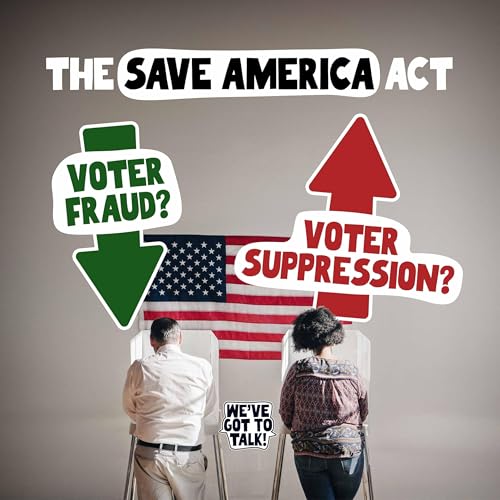
  • Trump’s SAVE Act Explained: Election Integrity or Voter Suppression
    Mar 18 2026

    Trump’s SAVE Act is being sold as a straightforward push for election integrity, but in this episode, we take a look at why it is not nearly that simple. On the surface, secure elections sound like an easy thing to support. But once you get into the details, the conversation becomes much more complicated. Is this really about protecting the vote, or is it about raising suspicion and adding new barriers just before the midterms?

    Nicole shares why her instinct is that the SAVE Act feels like a pre-midterm power move wrapped in the language of fairness. Jolene sees the appeal of a more standardized voting system, and both agree that public trust in elections matters. They also agree that handing too much control to the federal government comes with real risks, especially when centralised voter systems can create new vulnerabilities and new opportunities for overreach.

    The episode also digs into the practical impact of laws like this. What happens to people in rural areas, people without easy access to updated documents, women whose names do not match old paperwork, or communities that already face barriers to voting? Nicole argues that access is part of election integrity too, and that a system is not truly secure if it quietly pushes legitimate voters out of the process.

    At the heart of the conversation is a bigger question about democracy itself. If the goal is a better voting system, why are reforms so often introduced in the most politically explosive way possible? Why not build trust slowly, with time, support, and real buy-in from both sides? Nicole and Jolene ask what meaningful voter reform should actually look like, and how we protect both security and access without turning every election conversation into a loyalty test.

    CHAPTER MARKERS:

    00:00 Welcome

    00:26 What Is the SAVE Act

    00:58 Liberal Hot Takes

    03:47 Conservative Breakdown

    05:18 ID Requirements Debate

    07:20 Real ID Rollout Idea

    14:21 How Registration Would Work

    17:21 Immigration Fraud Claims

    21:20 Bipartisanship and Funding

    25:09 Midterms and Loopholes

    26:54 Voter Rolls and Turnout

    29:32 Bipartisan Wins Ignored

    30:47 Name Changes and IDs

    32:50 Registration Versus Voting

    35:46 Politics and Fraud Claims


    RESOURCES MENTIONED:

    https://campaignlegal.org/update/what-you-need-know-about-save-act

    LINKS:

    On Instagram https://www.instagram.com/wevegottotalk/

    On YouTube: https://www.youtube.com/@WeveGotToTalk

    How to find Nicole https://nicolefonarow.com/

    How to find Jolene https://dibledough.com/


    Show More Show Less
    44 mins
No reviews yet