• Australia’s Under-16 Social Media Ban vs. US Bell-to-Bell Phone Bans in Schools
    Apr 1 2026
    Two big stories have been sitting with us. Australia moving to ban social media for kids under 16, and U.S. schools rolling out “bell to bell” phone bans. Australia’s move is bold, and we don’t think anyone believes it will be perfect. Enforcement will be messy, there will be loopholes, and kids will try to get around it. But we still respect the statement it makes. It forces the conversation into the open and signals that constant, unsupervised access to algorithm-driven platforms is not a harmless childhood right. It is a risk, and adults need to stop pretending otherwise.Then there’s the U.S. “bell to bell” ban conversation, and it feels like another version of the same awakening. Not “put it on silent” or “keep it in your bag,” but actual phone-free school days. The point isn’t that adults hate technology. It’s that teachers are watching attention, learning, and social skills take a hit in real time. And when phones are removed from the classroom equation, something simple but powerful happens. Kids talk, play, make eye contact, and teachers report fewer distractions and more present students.In this episode, Jolene and I also talk about what these bans can and cannot do. A school ban can change the day, but kids still go home to devices. A social media ban can shift norms, but it won’t teach digital judgement on its own. That’s why we keep coming back to the bigger question: what does a healthier relationship with tech actually look like, and how do we build it on purpose? We would love to hear your take in the comments. Do you think Australia’s under-16 social media ban will help, or backfire? And should more U.S. schools go “bell to bell”?CHAPTER MARKERS:00:00 Intro02:02 Australia ban: covered platforms and expectation of glitches/workarounds03:38 Early workaround example and Meta removing underage accounts in Australia04:12 Online Safety Act timeline; no accounts under 16; can still browse without accounts05:22 Rationale: limiting algorithm-driven targeting and mental health harms07:10 Verification and enforcement: “reasonable steps,” accountability, and potential $30M fines10:16 Shift to US: 35 states + DC adopting bell-to-bell school phone bans12:02 Bipartisan dynamics, safety/shooting concerns, and workarounds15:25 Alternatives: flip phones, pagers/payphones; key stats on depression/sleep and public support17:52 Tech leaders restricting their own kids’ phone/social media use23:00 Broader reflection: problem-solving skills and attention in an always-online world26:20 Parenting boundaries: phones in rooms, supervised computer use, and saying no28:24 Nuance on school bans: concern about teaching responsible use vs. total prohibition30:13 Proposal: “digital citizenship” education alongside restrictions31:27 Discipline burden on teachers; varied state/school rules; request for educator feedback34:14 Surgeon General warning-label idea; debate over shame vs. action; multi-pronged solutions36:12 Safety concerns: predators and kids’ platforms like Roblox37:19 Social media design as addiction40:22 Modeling behavior: adults on phones and kids seeking attention42:04 Partisanship hypothetical: potential backlash if Trump pushed a phone-ban policy44:07 Closing takeaways: learn from Australia47:10 Would-you-rather questions; choosing YouTube as the one appRESOURCES MENTIONED:https://www.abc.net.au/news/2025-12-04/when-is-the-teen-social-media-ban-what-apps-are-banned/106086152https://www.abc.net.au/news/2025-11-19/roblox-brings-in-age-checks-ahead-of-australian-ban/106025742https://ministers.education.gov.au/clare/school-behaviour-improving-after-mobile-phone-ban-and-vaping-reformsGood for the Soul: https://www.instagram.com/weatheradam/?hl=enLINKS:On Instagram https://www.instagram.com/wevegottotalk/ On YouTube: https://www.youtube.com/@WeveGotToTalkHow to find Nicole https://nicolefonarow.com/How to find Jolene https://dibledough.com/
    Show More Show Less
    41 mins
  • The Epstein Files and the elite with no accountability
    Mar 25 2026
    The Epstein files are not just a scandal or a “true crime” story. They are a mirror held up to power, privilege, and the way exploitation can hide in plain sight when the right people are involved.We take a look at why this story is bigger than Jeffrey Epstein as an individual. The most disturbing part is not only what he did, but how long he operated, how many doors opened for him, and how an entire ecosystem of access, money, and silence helped protect him. This is where the conversation turns into something deeper about class, credibility, and why the hyper-elite often seem to live by different rules than everyone else.We also talk about the darker details that keep resurfacing, including the New Mexico “Zorro Ranch,” the eugenics angle, and the broader network of enablers that made Epstein’s world possible. And we ask the question that hangs over all of it. Will we ever know the full truth, the kind that maps the networks clearly and holds people accountable, not just the version that gets turned into gossip and outrage?Most importantly, we refuse to let this become a partisan weapon. This is not a left issue or a right issue. It is a human issue about whether justice is selective, whether accountability is optional for the wealthy and connected, and whether victims are treated as disposable. We want to hear your thoughts. What should accountability look like here, and do you believe we will ever get the full truth?CHAPTER MARKERS:00:00 Welcome00:23 Epstein Files Intro00:52 Three Hot Takes on Epstein Files04:51 Bipartisan Outrage07:21 How He Got Away08:58 Epstein Origin Story09:51 Wexner And Teen Culture14:25 Elite Money Blindness17:07 Plea Deal And Death19:04 New Mexico Eugenics20:02 Why No One Talks21:59 Philanthropy And Complicity23:15 Bill Gates Example24:29 Power Sex And Access25:08 Peter Attia Email Scandal26:34 Power Over Sex27:39 Hypersexualization Debate29:56 Epstein Files Politics35:32 Evidence And Accountability38:11 Would You Rather40:52 Final ThanksRESOURCES MENTIONED:The Epstein Files (Politics, subpoenas, and the current fallout)NYT (Feb 12, 2026): Epstein files overview / political anglehttps://www.nytimes.com/2026/02/12/us/politics/epstein-files.html?unlocked_article_code=1.RFA.Ks_d.pTEwL-KfzLEH&smid=url-shareNYT (Mar 4, 2026): Pam Bondi subpoena related to the Epstein fileshttps://www.nytimes.com/2026/03/04/us/politics/pam-bondi-subpoena-epstein-files.html?unlocked_article_code=1.RFA.ev5r.I-KWB7-Gs8oP&smid=url-shareNew Mexico / Zorro Ranch (location + operations)NYT (Mar 1, 2026): Epstein’s New Mexico “Zorro Ranch”https://www.nytimes.com/2026/03/01/us/jeffrey-epstein-new-mexico-zorro-ranch.html?unlocked_article_code=1.RFA.taQs.mfGbZ_Gv_DZe&smid=url-shareMedical network / enablers (doctors)NYT (Feb 28, 2026): Epstein and doctorshttps://www.nytimes.com/2026/02/28/us/jeffrey-epstein-doctors.html?unlocked_article_code=1.RFA.DT50.a3Mt3jihkdRH&smid=url-shareEugenics angle (historical reporting)NYT (Jul 31, 2019): Epstein and eugenicshttps://www.nytimes.com/2019/07/31/business/jeffrey-epstein-eugenics.html?unlocked_article_code=1.RFA.kPt3.sqD4Xrz4SYqG&smid=url-shareLINKS:On Instagram https://www.instagram.com/wevegottotalk/ On YouTube: https://www.youtube.com/@WeveGotToTalkHow to find Nicole https://nicolefonarow.com/How to find Jolene https://dibledough.com/
    Show More Show Less
    41 mins
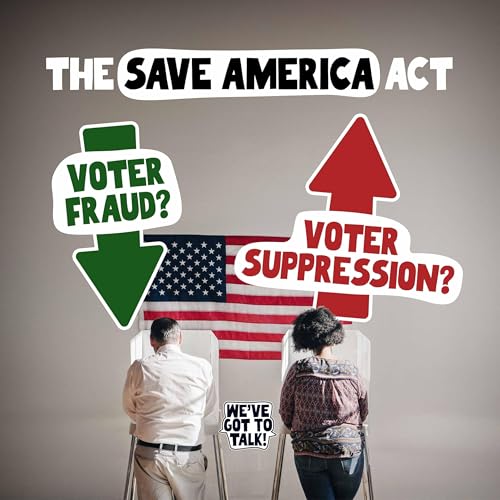
  • Trump’s SAVE Act Explained: Election Integrity or Voter Suppression
    Mar 18 2026

    Trump’s SAVE Act is being sold as a straightforward push for election integrity, but in this episode, we take a look at why it is not nearly that simple. On the surface, secure elections sound like an easy thing to support. But once you get into the details, the conversation becomes much more complicated. Is this really about protecting the vote, or is it about raising suspicion and adding new barriers just before the midterms?

    Nicole shares why her instinct is that the SAVE Act feels like a pre-midterm power move wrapped in the language of fairness. Jolene sees the appeal of a more standardized voting system, and both agree that public trust in elections matters. They also agree that handing too much control to the federal government comes with real risks, especially when centralised voter systems can create new vulnerabilities and new opportunities for overreach.

    The episode also digs into the practical impact of laws like this. What happens to people in rural areas, people without easy access to updated documents, women whose names do not match old paperwork, or communities that already face barriers to voting? Nicole argues that access is part of election integrity too, and that a system is not truly secure if it quietly pushes legitimate voters out of the process.

    At the heart of the conversation is a bigger question about democracy itself. If the goal is a better voting system, why are reforms so often introduced in the most politically explosive way possible? Why not build trust slowly, with time, support, and real buy-in from both sides? Nicole and Jolene ask what meaningful voter reform should actually look like, and how we protect both security and access without turning every election conversation into a loyalty test.

    CHAPTER MARKERS:

    00:00 Welcome

    00:26 What Is the SAVE Act

    00:58 Liberal Hot Takes

    03:47 Conservative Breakdown

    05:18 ID Requirements Debate

    07:20 Real ID Rollout Idea

    14:21 How Registration Would Work

    17:21 Immigration Fraud Claims

    21:20 Bipartisanship and Funding

    25:09 Midterms and Loopholes

    26:54 Voter Rolls and Turnout

    29:32 Bipartisan Wins Ignored

    30:47 Name Changes and IDs

    32:50 Registration Versus Voting

    35:46 Politics and Fraud Claims


    RESOURCES MENTIONED:

    https://campaignlegal.org/update/what-you-need-know-about-save-act

    LINKS:

    On Instagram https://www.instagram.com/wevegottotalk/

    On YouTube: https://www.youtube.com/@WeveGotToTalk

    How to find Nicole https://nicolefonarow.com/

    How to find Jolene https://dibledough.com/


    Show More Show Less
    44 mins
  • Iran Conflict: What Happens When "You Break It, You Buy It" Applies to War?
    Mar 11 2026

    Iran is one of the most loaded topics on the planet right now, and in this episode, Nicole (liberal) and Jolene (conservative) try to talk about it without pretending it’s simple. We recorded on Thursday, March 5th, fully aware that modern conflict moves fast and anything we say could age in a week. So this isn’t a “perfect take.” It’s us slowing the conversation down and naming what we know, what we don’t, and what we’re tempted to assume.

    Jolene opens with three hot takes, starting with the language. Five days in, she hesitates to call it a “war” and frames it as a conflict, not to minimise it, but because words shape expectations. “War” implies a timeline, a scale, and a level of commitment Americans are deeply wary of after Iraq and Afghanistan. She also wrestles with the tension between short-term necessity and long-term fallout, including what it signals to allies and adversaries if the U.S. hesitates, and what it costs if the U.S. gets pulled into something with no clear end.

    Nicole also gets stuck on the war versus conflict question, because labels shape what people tolerate and demand. We talk about the strategic side too, including the role of allies, technology, and how modern warfare has shifted toward precision, drones, cyber, intelligence, and targeted strikes. But underneath all of it is the question that never goes away: what is the plan? “Winning” is not clean, and moral certainty can become a shortcut that avoids the hard questions while real people pay the price.

    We also centre the part that can’t be treated like a chessboard: the Iranian people. We talk about the human cost already paid by protestors and ordinary citizens under an oppressive regime, and the uncomfortable questions about intervention, democracy, and what happens after a regime is weakened.

    Finally, we dig into the media layer and why “stay curious” matters more than ever. What are you watching? What are you worried about? What do you think the U.S. responsibility is here, if any? Drop your thoughts in the comments and keep it respectful.

    CHAPTER MARKERS:

    00:00 Welcome

    00:25 Iran Conflict

    01:10 Jolene Three Hot Takes

    03:31 Allies And Drones

    04:16 No Long Term Plan

    05:16 Human Cost And Protest

    07:09 How We Got Here

    10:25 Be Curious Learn History

    12:38 Kurds And Civil War Risk

    14:58 War Powers And Congress

    18:22 Moral Cost Of Strikes

    21:10 What Happens After

    23:35 Succession and Assassination

    23:54 Intel Infiltration Strategy

    25:40 Iran Threats and Trump

    26:27 Israel Discourse and Antisemitism

    27:15 Hamas and Campus Protests

    29:15 Iran Voices on Instagram

    31:05 Media Fear and Polling

    33:38 Who Builds a New Middle East

    35:48 Would You Rather War Outcomes

    37:50 Noem Jet and Lewandowski

    41:36 Podcast Wrap

    RESOURCES MENTIONED:

    Instagram: @hemdad.nazari

    https://youtu.be/e9dljIL4rBk?si=q0Jjj5oN2uDcJPPg


    LINKS:

    On Instagram https://www.instagram.com/wevegottotalk/

    On YouTube: https://www.youtube.com/@WeveGotToTalk

    How to find Nicole https://nicolefonarow.com/

    How to find Jolene https://dibledough.com/

    Show More Show Less
    44 mins
  • The Death of Political Decorum: Pam Bondi, JD Vance, and Why We're All Exhausted
    Mar 4 2026

    Politics lately feels less like governing and more like bad behavior. In this episode, we ask a simple question: where did basic political decorum go, and why does it feel like the whole country is running on outrage and adrenaline?

    We talk about congressional hearings that feel more like theatre than truth-seeking, including the Pam Bondi exchange during the Epstein hearings. Tough questions are part of the job, but the posturing, rehearsed lines, and made-for-camera moments leave us wondering who the real audience is. When oversight becomes performance, it doesn’t just waste time. It teaches the public that politics is about winning the clip, not solving problems.

    We also unpack how modern media and social platforms amplify the worst incentives. Sensational headlines, rage-bait framing, and constant “gotcha” coverage keep everyone stressed, divided, and exhausted. We ask whether changes like removing cameras from hearings or tightening rules could reduce the made-for-TV drama, while still protecting transparency.

    Finally, we look at what “adult discourse” could sound like again, including our reaction to Marco Rubio’s Munich speech, and the bigger tension between relatability and responsibility in leadership. We also talk about the double standard women face in public life, where forcefulness is praised in men and punished in women. If you’re exhausted too, tell us in the comments. What would you reward in a leader if the algorithm wasn’t in the room?


    CHAPTER MARKERS:

    00:00 Introduction

    00:25 Decorum In Politics in Disappearing

    02:07 Hearings As Theater

    02:26 Tabloid Media Machine

    06:08 Fixing The Congressional Hearing Format

    07:41 Pam Bondi Performing For Trump

    09:59 Rubio Munich Adult In Room

    12:34 JD Vance Speech Comparison

    13:17 Rubio Then And Now

    14:46 What Calm Leadership Feels Like

    16:10 Outrage Gets Attention

    16:42 Trump Reads The Room

    19:22 Authentic Not Rude

    21:09 Women And Double Standards

    26:13 Rage Bait And Civility

    26:59 Modeling Respectful Debate

    28:16 Would You Rather Segment

    30:56 Closing Thoughts


    RESOURCES MENTIONED:

    https://www.foxnews.com/media/how-pam-bondi-democrats-turned-hearing-hysteria-right-front-jeffrey-epsteins-victims


    LINKS:

    On Instagram https://www.instagram.com/wevegottotalk/

    On YouTube: https://www.youtube.com/@WeveGotToTalk

    How to find Nicole https://nicolefonarow.com/

    How to find Jolene https://dibledough.com/


    Show More Show Less
    32 mins
  • Bridge Grades: The ‘Rotten Tomatoes’ Scorecard for Congress
    Feb 25 2026

    We’re sitting down with Brad Porteus, the creator of Bridge Grades, to talk about the one thing American politics is starving for right now: real collaboration. If you are exhausted by tribal “pick a side” thinking, this conversation is a breath of fresh air, because it is not about who is right. It is about who can actually work with people they disagree with.

    Brad explains what Bridge Grades is and why he built it. Think of it as a report card for Congress, or like Rotten Tomatoes for politicians. Using objective third-party data, Bridge Grades scores members of Congress from 0 to 100 based on how collaboratively or divisively they govern. The big idea is simple but powerful: ideology and collaboration are independent variables. You can be conservative and still be a bridge-builder. You can be progressive and still be a divider.

    We also get into the uncomfortable part. Are citizens rewarding the behaviour they claim they want? Brad talks about how American politics has become identity warfare, and how incentives now favour viral moments, party loyalty, and public dunking over the slow, unglamorous work of governing.

    If you are looking for a better way to evaluate politicians beyond red vs blue, this episode will give you a new lens.

    Check out Bridge Grades here: https://www.bridgegrades.org/ and tell us what you think. Who are the real bridgers in Congress, and what would it take for voters to start rewarding collaboration at the ballot box?

    CHAPTER MARKERS:

    00:00 Introduction

    01:08 Explaining Bridge Grades

    02:44 Brad's Background and Inspiration

    06:09 Challenges in Political Engagement

    08:46 The Role of Media and Algorithms

    19:21 Grading System and Data Sources of Bridge Grades

    26:12 Encouraging Bipartisanship

    32:09 Exploring Alternatives to the Two-Party System

    32:52 The Dream of Normalizing Bridging Politics

    33:27 Challenges in Changing Voting Behavior

    34:03 The Role of Bridge Grades in Political Campaigns

    34:35 Reinviting Disengaged Voters

    36:23 The Two-Punch Strategy for Political Change

    37:32 Building a Public Utility for Political Transparency

    38:16 The Builders Movement and Bridging Efforts

    39:00 Evaluating Politicians' Actions and Rhetoric

    41:27 Encouraging Bipartisanship in Congress

    47:25 Hope for a Collaborative Future in Politics

    49:52 Good for the Soul: Live Music and Gen X Memoirs

    51:58 Would You Rather

    RESOURCES MENTIONED:

    Bridge Grades:

    https://www.bridgegrades.org/

    Good For The Soul:

    Remember to go and see live music!

    https://book-shelfie.com/roll-with-it/

    https://liberationbway.com/

    LINKS:

    On Instagram https://www.instagram.com/wevegottotalk/

    On YouTube: https://www.youtube.com/@WeveGotToTalk

    How to find Nicole https://nicolefonarow.com/

    How to find Jolene https://dibledough.com/

    Show More Show Less
    59 mins
  • The Last Republican Documentary: Our Review
    Feb 18 2026

    We just watched “The Last Republican,” Steve Pink’s new documentary about Adam Kinzinger - the Illinois Congressman who broke ranks with his party after the January 6th hearings, and let’s just say, it sparked a conversation. Actually, several. We’re Nicole (liberal) and Jolene (conservative), friends for nearly 40 years and living proof that you can tackle politics, religion, and money without ending up in a shouting match. In this episode, we give you our take on the film, the politics, and the very human messiness at the heart of it all.

    Despite our different political leanings, we came away agreeing on something important: accountability matters, and so does honest conversation about our history. No matter how uncomfortable it is. If we want a better future, we have to be willing to look back, learn, and talk it out, even when it’s messy.

    “The Last Republican” isn’t just a documentary about one man or one party, it’s a mirror held up to the state of American politics and an invitation to have the kinds of conversations most people avoid. We hope you’ll watch it, and then talk about it with people who agree with you, and especially with those who don’t. That’s where real understanding starts.

    RESOURCES MENTIONED:

    The Last Republican Buy Or Rent:

    https://www.youtube.com/watch?v=ksFrcUdEa9A

    Good For the Soul:

    Instagram:

    @vhsdates

    @top.music.songs

    www.bridgegrades.org

    LINKS:

    On Instagram https://www.instagram.com/wevegottotalk/

    On YouTube: https://www.youtube.com/@WeveGotToTalk

    How to find Nicole https://nicolefonarow.com/

    How to find Jolene https://dibledough.com/

    Show More Show Less
    50 mins
  • Trump One Year Later: Reaction to Ezra Klein & Yuval Levin Conversation
    Feb 11 2026

    We’re sharing our take on Ezra Klein’s interview with Yuval Levin and the question it raises about Trump’s presidency: has he achieved as much as it feels like he has, or are we confusing constant motion with durable progress? We talk about why this administration can feel like nonstop action, even when much of that action is not coming through Congress.

    A big idea from the Ezra Klein Show conversation is Levin’s framing that Trump governs “retail rather than wholesale.” In other words, prioritizing visible, immediate wins through executive power, pressure, and deal-making, instead of building long-lasting policy through legislation. We unpack why that approach appeals to many voters who wanted a non-politician who would bypass gridlock, and why it also raises concerns about stability when executive orders can be reversed by the next administration.

    We also dig into the political reality that Trump’s brand can make bipartisan cooperation in Congress even harder, pushing everyone toward obstruction and performance, and pushing the White House toward even more executive action. The bigger question we leave you with is simple: is Trump adapting to a broken legislative branch, or is this style of leadership making it harder for Congress to function at all?

    CHAPTER MARKERS:

    00:00 Introduction

    00:45 Discussing Listener's Suggestion: Ezra Klein and Yuval Levin

    01:58 Trump's First Year: Accomplishments and Controversies

    04:00 Debating Congressional vs. Executive Power

    05:57 Trump's Approach to Governance

    07:59 Media Perception and Legal Battles

    18:24 Young Conservatives and Political Extremism

    20:51 US Dependency and Federal Funding

    22:56 Trump as a Disruptor

    23:25 Checks and Balances Concerns

    25:58 Media Manipulation and Public Perception

    27:01 Trump's Spending and Defense Policies

    29:07 Hopes for Congressional Bravery

    30:07 America's 250th Birthday

    33:28 Good for the Soul: Snowfall and Peace

    35:24 TV Show Recommendation: The West Wing

    38:31 Would You Rather


    RESOURCES MENTIONED:

    Ezra Klein and Yuval Levin Interview:

    https://youtu.be/WJHPaCaMAq4?si=9jnNnea6mPoGj0hf

    Senate website/Presidential Nominations Withdrawn: https://www.senate.gov/pagelayout/legislative/one_item_and_teasers/nom_wdr.htm


    LINKS:

    On Instagram https://www.instagram.com/wevegottotalk/

    On YouTube: https://www.youtube.com/@WeveGotToTalk

    How to find Nicole https://nicolefonarow.com/


    How to find Jolene https://dibledough.com/

    Show More Show Less
    41 mins