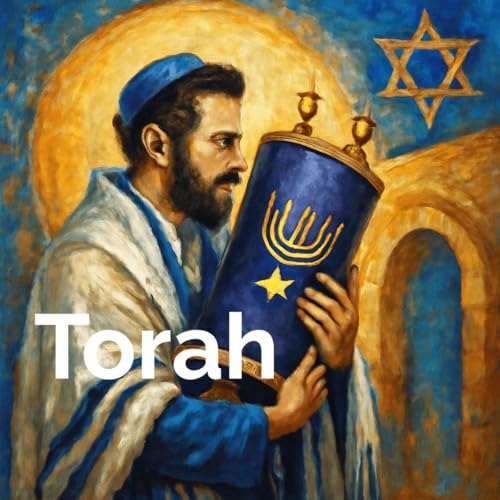
Torah. cover art

Torah.

Torah.

By: Popular Culture and Religion.
Listen for free

Summary

What is the Torah? Torah is a Hebrew word meaning “to instruct.” The Torah refers to the five books of Moses in the Hebrew Bible/Old Testament (Genesis, Exodus, Leviticus, Numbers, and Deuteronomy). The Torah was written approximately 1400 BC. Traditionally, the Torah is handwritten on a scroll by a “sofer” (scribe). This type of document is called a “Sefer Torah.” A modern printing of the Torah in book form is called a “Chumash” (related to the Hebrew word for the number 5).

Here is a brief description of the five books of the Torah:
- Genesis: This first book of the Torah includes 50 chapters and covers the time period from the creation of all things to the time of Joseph’s death and burial. It includes the account of creation (chapters 1—2), the beginning of human sin (chapter 3), Noah and the ark (chapters 6—9), the tower of Babel (chapters 10—11), the lives of Abraham, Isaac, and Jacob, and an extended narrative of the life of Joseph.
- Exodus: This second book of the Torah includes 40 chapters and covers the period from Jewish slavery in Egypt until the glory of the Lord descended upon the completed tabernacle in the wilderness. It includes the birth of Moses, the plagues of Egypt, the exodus of the Jewish people from Egypt, the crossing of the Red Sea, and the giving of the Law to Moses upon Mount Sinai.
- Leviticus: This third book of the Torah includes 27 chapters and consists largely of the laws regarding sacrifices, offerings, and festivals among the people of Israel.
- Numbers: This fourth book of the Torah includes 36 chapters and covers a span of about 40 years as the Israelites wandered in the wilderness. Numbers provides a census of the people of Israel and some details about their journey toward the Promised Land.
- Deuteronomy: This fifth book of the Torah includes 34 chapters and is called “Deuteronomy” based on a Greek word meaning “second law.” In the book, Moses repeats the Law for the new generation who would enter the Promised Land. Deuteronomy describes the transition of leadership sacerdotally (from Aaron to his sons) and nationally (from Moses to Joshua).

The Torah’s five books have formed the basis of Judaism’s teachings from the time of Moses. Later biblical writers, including Samuel, David, Isaiah, and Daniel, would frequently refer back to the Law’s teachings. The teachings of the Torah are frequently summarized by citing Deuteronomy 6:4–5, called the Shema (or “saying”): “Hear, O Israel: The LORD our God, the LORD is one. You shall love the LORD your God with all your heart and with all your soul and with all your might.” Jesus called this the “first and greatest commandment” (Matthew 22:36–38).
The Torah is considered the inspired Word of God by both Jews and Christians alike. Christians, however, see Jesus Christ as the fulfillment of the Messianic prophecies and believe the Law was fulfilled in Christ. Jesus taught, “Do not think that I have come to abolish the Law or the Prophets; I have not come to abolish them but to fulfill them” (Matthew 5:17).


Copyright Popular Culture and Religion.
Judaism Spirituality
Episodes
  • Contemporary Debates.
    May 13 2026
    Contemporary Debates. Persistence of Mosaic Authorship Views. In Orthodox Judaism, the attribution of the Torah's authorship to Moses remains a core doctrinal tenet, with the text regarded as divinely dictated to him at Sinai around the 13th century BCE, including all but the final eight verses recounting his death. This view, rooted in rabbinic tradition and upheld without significant dissent in Orthodox circles, posits that Moses transcribed the material verbatim under God's instruction, as referenced in passages like Deuteronomy 31:9 where Moses is described as writing "this torah" and delivering it to the priests. Surveys of Jewish denominational beliefs indicate near-universal adherence among Orthodox Jews, contrasting with more varied positions in Conservative and Reform branches influenced by 19th-century higher criticism. Among evangelical Christians, Mosaic authorship persists as a defended position, often integrated into doctrines of biblical inerrancy, with proponents arguing that internal textual claims—such as Moses' recording of laws in Exodus 24:4 and Numbers 33:2—align with New Testament affirmations like John 5:46-47 where Jesus references Moses' writings. Organizations like Answers in Genesis and Reasons to Believe cite linguistic, archaeological, and historical consistencies, such as Egyptian loanwords in the text fitting a 15th-13th century BCE milieu, to counter documentary hypothesis challenges. Evangelical seminaries and publications, including those from Ligonier Ministries, continue to teach this view, emphasizing that rejection of Mosaic unity often stems from presuppositional naturalism rather than conclusive empirical disproof. Contemporary Jewish scholars like Joshua Berman and the late David Zvi Hoffmann have advanced arguments against source-critical fragmentation, highlighting thematic unity and covenantal structures that cohere under single authorship, while evangelical figures such as those at Apologetics Press marshal external attestations from ancient Near Eastern parallels and early church fathers. These defenses persist amid mainstream academic consensus favoring multiple authors over centuries, which some critics attribute to methodological biases prioritizing evolutionary models over traditional testimonies, yet empirical reevaluations of textual variants and manuscript evidence sustain the Mosaic case for a substantive minority of researchers. Impacts of Recent Scholarship and Archaeology. Recent scholarship on the Torah has increasingly emphasized its composite nature, attributing composition to multiple authors and redactors spanning from the monarchic period through the Persian era, rather than single Mosaic authorship around the 13th century BCE. Linguistic analysis reveals Hebrew features consistent with Iron Age (c. 1000–500 BCE) usage, including late grammatical forms and vocabulary absent in earlier Semitic texts, undermining claims of 2nd-millennium BCE origins. This view, advanced in works like those building on the Documentary Hypothesis, posits the Pentateuch as a product of Israelite scribal traditions reflecting exilic and post-exilic theological concerns, such as covenant renewal amid national trauma. Archaeological investigations have profoundly impacted interpretations of the Torah's narratives, particularly the Exodus and wilderness accounts. Extensive surveys of the Sinai Peninsula, including over 100 prospective sites from the Late Bronze Age (c. 1550–1200 BCE), have yielded no traces of large-scale Semitic migrations or encampments capable of sustaining the biblical population of 600,000 men plus families. Egyptian records, abundant for labor management and Asiatic interactions, contain no references to a mass Hebrew slave exodus or plagues disrupting the Nile Delta economy during Ramesses II's reign (c. 1279–1213 BCE), the traditional pharaonic backdrop. These absences have bolstered minimalist positions, viewing the Exodus as etiological myth or exaggerated folk memory of smaller Canaanite upheavals, rather than verifiable history. Conversely, select findings offer indirect support for early Israelite literacy and cultural elements in the Torah. The Ketef Hinnom silver amulets (c. 600 BCE), inscribed with the Priestly Blessing from Numbers 6:24–26, demonstrate pre-exilic familiarity with Pentateuchal phrasing, suggesting textual traditions predating the Babylonian exile. Proto-Sinaitic inscriptions from Serabit el-Khadim (c. 19th–15th century BCE) indicate Semitic alphabetic writing in Egyptian contexts, compatible with Mosaic-era literacy hypotheses, though not directly linked to Hebrew law codes. The Merneptah Stele (c. 1207 BCE) attests to an entity "Israel" in Canaan, establishing a proto-Israelite presence by the late 13th century BCE, yet without corroborating conquest motifs from Joshua integrated into the Torah's framework. These developments have reshaped Torah studies by prioritizing empirical ...
    Show More Show Less
    7 mins
  • Islamic Tawrat.
    May 13 2026
    Islamic Tawrat.
    In Islamic theology, the Tawrat denotes the divine revelation bestowed upon the prophet Musa (Moses) to serve as guidance for the Banu Isra'il (Children of Israel). The Quran references the Tawrat eighteen times, portraying it as a source of huda (guidance) and nur (light) through which earlier prophets rendered judgments among their communities. Specifically, Quran 5:44 states: "Indeed, We sent down the Torah, in which was guidance and light. The prophets who submitted [to Allah] judged by it for the Jews, as did the rabbis and scholars by that with which they were entrusted of the Scripture of Allah." This positions the Tawrat as one of four major scriptures in the Islamic chain of revelation, preceding the Zabur (Psalms) given to Dawud (David), the Injil (Gospel) to Isa (Jesus), and culminating in the Quran itself.
    Muslim doctrine holds that the original Tawrat comprised Mosaic laws (shari'ah), moral commandments, and historical narratives concerning creation, prophets, and divine covenants, aligning in broad outline with the Pentateuch's content but originating directly from Allah's speech to Musa on Mount Sinai. Unlike the Quran, which Muslims regard as verbatim preserved since its revelation in 610–632 CE, the Tawrat is believed to have undergone tahrif—distortion—effected by Jewish scribes and leaders through textual alterations (tahrif al-lafz) or deliberate misinterpretations (tahrif al-ma'na). Quranic verses cite instances of such changes, including twisting words from their contexts or concealing truths for worldly gain, as in 4:46: "Among the Jews are those who distort words from their [proper] usages," and 5:13: "They distort words from their [proper] places." This view, elaborated in post-Quranic exegeses like those of al-Tabari (d. 923 CE), reconciles doctrinal divergences between the Quran and Jewish texts by attributing inconsistencies to human intervention rather than divine error.
    Notwithstanding the doctrine of tahrif, the Quran validates the Tawrat extant during the Prophet Muhammad's era (circa 610–632 CE), urging Jews to adjudicate by it: "And let the People of the Gospel judge by what Allah has revealed therein" parallels instructions for the Torah in 5:43, implying residual authenticity amid corruptions. Classical scholars such as Ibn Hazm (d. 1064 CE) argued for wholesale textual corruption post-Musa, while others like al-Razi (d. 1209 CE) emphasized interpretive distortion, allowing selective affirmation of Pentateuchal elements compatible with Islamic monotheism, such as monotheistic declarations and ethical prohibitions. No physical copy of the pristine Tawrat survives in Islamic tradition; hadiths occasionally reference its lost contents, like prohibitions on usury or Sabbath observances, but Muslims rely solely on the Quran for authoritative guidance.
    The Tawrat's legal prescriptions, including rituals like circumcision and dietary laws, are seen as abrogated (mansukh) by subsequent revelations, particularly the Quran, which supersedes prior scriptures in universality and finality. This abrogation underscores Islam's self-conception as the corrective culmination of Abrahamic faiths, with the Tawrat's role confined to its historical context among the Israelites. Empirical scrutiny of manuscript traditions, such as Dead Sea Scrolls dating to 250 BCE–68 CE, reveals textual stability predating Islam, challenging claims of post-Mosaic wholesale alteration, though Islamic apologetics maintain that corruptions occurred incrementally, including during the Babylonian exile (586–539 BCE). Mainstream Sunni and Shia sources uniformly uphold the Tawrat's revelatory origin while subordinating it to Quranic primacy, cautioning against uncritical reliance on extant versions due to suspected interpolations favoring anthropomorphic depictions of God or prophetic flaws absent in Islamic narratives.


    This episode includes AI-generated content.
    Show More Show Less
    5 mins
  • Christian Old Testament.
    May 13 2026
    Christian Old Testament.
    The Christian Old Testament incorporates the Torah as its foundational component, consisting of the five books—Genesis, Exodus, Leviticus, Numbers, and Deuteronomy—collectively termed the Pentateuch. These books are universally included in the Old Testament canons of Protestant, Catholic, and Eastern Orthodox traditions, forming the initial segment before historical, prophetic, and wisdom literature. While Protestant Bibles align the Old Testament's 39 books with the Jewish Tanakh's content for the Pentateuch, Catholic and Orthodox versions add deuterocanonical books elsewhere but retain the identical Torah texts.
    Early Christian communities adopted the Pentateuch from Jewish scriptures, predominantly through the Septuagint, a third-century BCE Greek translation produced for Hellenistic Jews in Alexandria. This version, which rendered the Hebrew Torah into Koine Greek, became the primary Old Testament text for Greek-speaking Christians and is quoted over 300 times in the New Testament, with many direct citations from the Pentateuch, such as Deuteronomy 6:5 in Matthew 22:37 The Septuagint's Pentateuch occasionally diverges from the later Masoretic Text, including variant chronologies in Genesis (e.g., longer pre-flood lifespans) and textual expansions, influencing early patristic interpretations.
    In Christian theology, the Torah represents the covenant law mediated by Moses, establishing God's moral order, sacrificial system, and ethical imperatives for Israel. New Testament authors, including Jesus, affirm its authority—Jesus declaring in Matthew 5:17 that he came not to abolish the law but to fulfill it—yet portray it as preparatory, exposing human sinfulness and anticipating redemption through Christ (Galatians 3:24). Mainstream interpretations distinguish enduring moral laws (e.g., Ten Commandments) from ceremonial and civil ordinances deemed fulfilled or obsolete post-resurrection, as in Colossians 2:16-17, though some traditions like Seventh-day Adventists retain select observances such as Sabbath-keeping. This framework underscores typology, where Torah narratives and rituals prefigure Christian doctrines, such as Passover symbolizing Christ's sacrifice (1 Corinthians 5:7).
    Later translations, including Jerome's Latin Vulgate (completed 405 CE) and Reformation-era versions like the King James Bible (1611), drew from Hebrew manuscripts for the Pentateuch while preserving Septuagint influences in quotations. Modern critical scholarship notes archaeological and textual evidence supporting the Pentateuch's historical framework, such as Egyptian influences in Exodus, but debates Mosaic authorship, with conservative scholars upholding substantial Mosaic origin based on internal claims and early attestation. Christian engagement with the Torah thus emphasizes its revelatory role in salvation history, distinct from Jewish halakhic application.


    This episode includes AI-generated content.
    Show More Show Less
    3 mins
adbl_web_anon_alc_button_suppression_c
No reviews yet